Bajorian Counsler
The Science Center on September 15, (Friday) from 10a.m.-5p.m. Uniform is mandatory
The Science Center on September 15, (Friday) from 10a.m.-5p.m. Uniform is mandatory
ANY Star Trek Uniform is mandatory
ANY Star Trek Uniform is mandatory
https://www.mtaloy.edu/mac-news/mount-aloysius-hosts-third-annual-charity-comic-con/
Nov 3rd, 2018
from 10-4pm
Description of
What We Do...
Making Fiction into non-fiction
List of Activities we do with description
We offer not only a slide show presentation of Star Trek tech and the real use of it but also have visual real props for you to see. For the past 55 years, Star Trek has been influencing and prediction new gadgets and technologies.
Our table at a local con, comparing Star Trek's tech to real life tech
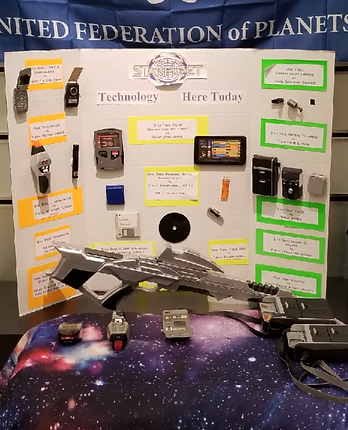

Upgraded Star Trek's tech board
Latest Star Trek's tech board is 6 foot


We show how to build an icy model of a comet, complete with shooting jets. This activity provides an opportunity for students to make observations, discuss changing states of matter and demonstrate measuring skills
A thermal camera image of Executive Officer Rocco holding a freshly made comet.
Notice how dark the comet is?

Got a new telescope and don't know how to use it? We'll teach you! A couple of our crew are experts at using telescopes. We can even set up for solar observations!
Dont know how to observe the Night Sky? NO Problem. Our Steller Cartographies will help you out.
Getting ready to observe the cosmos!


Learn how to set up the scope.
Here Tactical Officer Joyce is setting up the command pad so the scope can track celestial objects.
We offer FREE Safe Solar Viewing (weather permitting). Learn about Sun Spots.
Ever see craters on the moon close up? Here is your chance. How about the Moons of Jupiter or the Rings of Saturn?
The Captain and First Officer setting up for Solar Observations

The Commandering Officer (CO) and First Officer (XO) getting ready for Solar Observation. (Our 1st away mission together)
The Moon is around 240,000 miles (385,000 km) away from the Earth. But what how do you see how large that really is? If the Earth were a basketball, how large would the moon be, and how far away would it be? That is one of the many questions our crew can answer!

The relative sizes of the planets seem to be in scale, however the distances between them are not. The Moon (Luna) would be slightly larger than Pluto. Hint: If the Earth were a basketball, the diameter of the Sun would be more than three times the size of the Buhl Planetarium's dome! Image found at https://janus.astro.umd.edu/front/pages/links/images/Solarsystem1.1.jpg